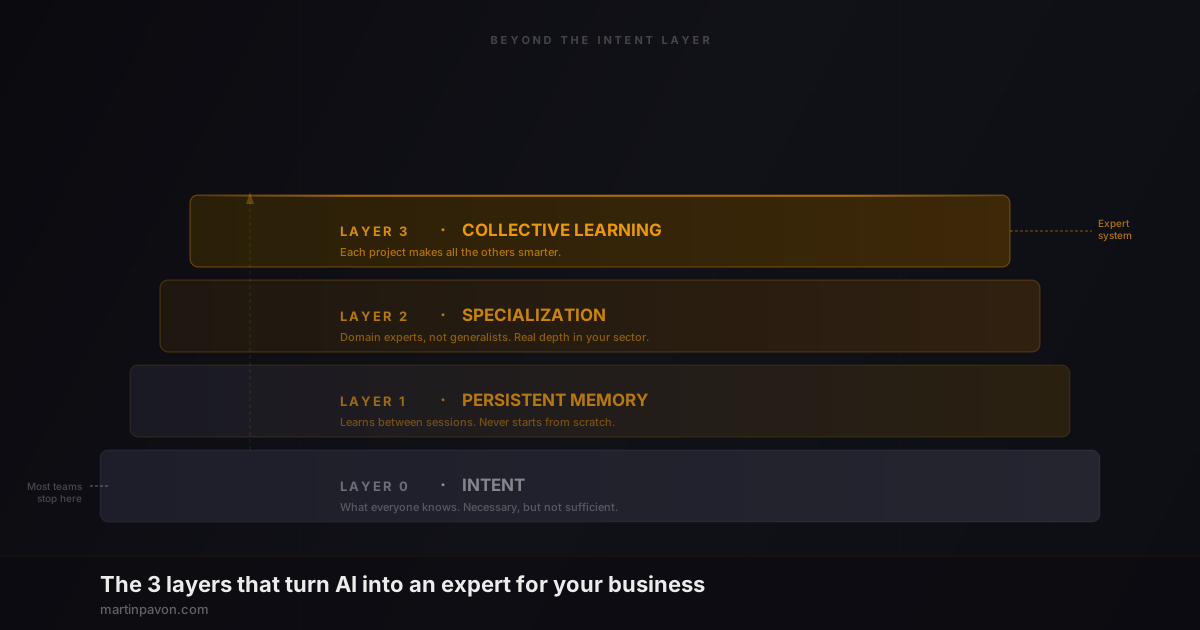

Everyone learns to talk to AI. No one talks about what comes next.
You've been using artificial intelligence for months. You've learned to write good prompts. To give context. To be specific about what you ask for. And it works — for one-off tasks, AI helps you do more in less time.
But there's something you've probably noticed: every time you start a new session, it's like starting from scratch. The AI doesn't remember what you learned together. It doesn't know the decision you made last Tuesday. It doesn't know why things are done a certain way in your business.
Intent defines what you want the AI to do. The upper layers define whether it actually gets it done.
The good news is that this problem has a solution. The bad news: most AI guides only talk about the first layer and stop there.
Why 90% of AI systems stay on the surface
There is what we call the intent layer: it's the moment you tell the AI what you want. A prompt. An instruction. A task. It's necessary. It's the starting point. But it's not enough.
When a company says "we already use AI," it almost always means this: they use AI tools for specific tasks, with well-written instructions, getting acceptable results. It's a good start.
- Layer 0Intent
- One-off instructions. The tool doesn't learn, doesn't remember, doesn't specialize.
- Layer 1Memory
- The system remembers previous decisions and improves with each session.
- Layer 2Specialization
- Domain experts, not generalists. Real depth in your sector.
- Layer 3Learning
- Each project makes all the others smarter.
The problem is that staying at Layer 0 is like hiring someone brilliant and having them start from scratch every Monday. They have the capability, but they have no continuity. And without continuity, there's no real expertise.
The 3 layers that separate the tool from the expert system
Layer 1: Persistent memory
Persistent memory is the system's ability to remember what it learned — not within a session, but between sessions. Between days. Between projects.
Imagine you have a collaborator who has been working with you for six months. They know your preferences. They know which solutions you've already tried and didn't work. They understand why certain decisions were made one way and not another. You don't have to explain the context every time.
That's what persistent memory does in a well-designed AI system.
Without memory
Every session starts from scratch
- You have to re-explain context
- Past mistakes get repeated
- No evolution between sessions
- The AI is always "new" to your business
With persistent memory
The system accumulates knowledge
- Remembers decisions and reasoning
- Learns from past mistakes
- Improves with every interaction
- Operates like someone who already "knows" your business
Persistent memory isn't magic — it's architecture. It requires designing how and what gets saved, when it's consulted, and how it's updated. But the result completely transforms the utility of the system.
Layer 2: Domain specialization
A general practitioner and a cardiac surgeon share the same base of medical knowledge. But if you have a heart problem, you don't want the generalist.
The same applies to AI. A generic system can answer questions on almost any topic with reasonable competence. But in your specific sector — with its terminology, its legal particularities, its unique business patterns — a specialized system goes where the generalist can't.
Specialization isn't achieved just by giving the AI more information. It's achieved by designing systems that know what to look for, how to interpret it, and how to apply it. It's the difference between a collaborator who knows a little about everything and an expert who knows your industry in depth.
Layer 3: Collective learning
This is the layer businesses underestimate most, and the one that generates the most value over time.
Collective learning is when the discoveries from one project don't stay in that project. They are captured, processed, and turned into knowledge available for all future projects.
Each project makes all the others smarter. That's the compounding effect of well-designed AI systems.
If we detect a recurring problem pattern in one project, that knowledge becomes available. If we find an especially effective solution for a type of challenge, the system learns it. Not as archived data — as an active principle that informs future decisions.
The result is a system that improves continuously, not through external updates, but through the work it already does. A knowledge ecosystem that feeds itself.
The 4 Layers of AI Systems: Comparison Table
| Layer | What it provides | Without it | With it |
|---|---|---|---|
| 0 — Intent | Instructions for the current task | Nothing works | Basic task execution |
| 1 — Persistent memory | Continuity across sessions | Starts from scratch daily | Builds on prior work |
| 2 — Domain specialization | Deep industry knowledge | Generic answers | Expert-level responses |
| 3 — Collective learning | Insights shared across projects | Each project reinvents the wheel | Compounding improvement |
According to IBM's AI adoption research, only 16% of companies have moved beyond basic AI tool use to systems with persistent memory or specialization. The 84% majority are permanently at Layer 0.
3 Questions to Diagnose Your Current Layer
Answer these to know exactly where your AI system stands today:
- Memory test: Does your AI know a decision you made 3 weeks ago without you explaining it again? If no, you are at Layer 0.
- Specialization test: Does your AI understand the specific terminology and workflows of your industry without prompting? If no, you are at Layer 0 or 1.
- Learning test: When a problem is solved in one project, does that solution automatically inform the next project? If no, you are at Layer 0, 1, or 2.
83% of businesses using AI tools are at Layer 0 — they have capable tools with no accumulation, no specialization, and no compounding value over time.
What this looks like in a real business
Imagine an event management company. They start using AI for standalone tasks: drafting emails, summarizing budgets, organizing supplier lists. Layer 0. Useful, but limited.
When they add persistent memory, the system starts remembering preferred suppliers, the negotiation patterns that work, the decisions made at similar events. Every new task starts from an accumulated context.
When they add specialization, the system understands the difference between a 200-person corporate event and an 80-person wedding. It knows setup times, the sector's typical margins, the most common contract clauses. It doesn't need to be told.
And when they add collective learning, the problem that came up at the March event — and the solution they found — is already available so it doesn't happen again. The team doesn't have to rediscover what they already know.
One-off tool
Active memory
Real specialization
Expert system
From tool to system: a shift in perspective
The difference between using AI and having an expert AI system isn't in the model you choose. It's in the architecture you build around it.
The companies getting the most significant results with AI in 2026 aren't necessarily the ones with access to the most powerful models. They're the ones who have designed systems with all four layers: well-defined intent, memory that accumulates, specialization that deepens, and learning that shares.
If you want to go deeper on any of these layers, the articles on context engineering, the AI performance equation, and AI maturity levels complete the full picture.
And if you want to assess where your company stands — and what it would need to take the next step — we can look at it together.
The Compounding Value of Each Layer
The business impact of each layer is measurable:
- Adding persistent memory reduces onboarding time for new AI tasks by 4 to 6x
- Domain specialization cuts error rates by approximately 3x vs a generalist system on the same tasks
- Businesses with all 4 layers report resolving customer issues in 8 minutes vs 45 minutes without the layers
- Collective learning means the 10th project in a domain is completed 2x faster than the first
- Systems with all layers fully implemented require human review only 1 vez per 10 outputs vs constant review without them