
You Have a Ferrari in First Gear
Imagine this: you buy the most powerful car on the market. V12 engine, 800 horsepower, Formula 1 engineering. You drive it off the lot, press the accelerator... and it won't go above 25 mph.
It's not the engine. It's that you never left first gear.
That's exactly what happens to most companies with artificial intelligence in 2026. They have access to incredibly powerful tools — more powerful than anyone would have dreamed two years ago. And yet, the results are mediocre.
The complaint always sounds the same: "We tried AI, but it doesn't work for our use case." Or worse: "We use AI, but I don't notice a difference."
The problem isn't the tool. The problem is that you're using 10% of its real capacity.
The AI you're using is probably already good enough. What's missing isn't power — it's strategy.
The Model Trap: Everyone Is Looking for the Wrong Engine
When a company decides to "adopt AI", the first question is usually: "Which model do we use? Which is the best?"
It's a logical question. But it's the wrong question.
It's like a restaurant with service problems deciding the solution is to buy more powerful ovens. The oven can be spectacular — but if the team doesn't have clear recipes, if no one monitors timing, if you can only cook one dish at a time... the oven doesn't matter.
The tech industry has spent years feeding this obsession with the model. Every week a new one comes out. Every benchmark promises that this one is the definitive answer. And companies fall into an exhausting cycle of trying, switching, trying another, without anything fundamentally changing.
The reality? In 2026, model power is no longer the bottleneck. Current models are more than sufficient for 90% of business tasks. What's missing are the other three factors that nobody tells you about.
The Equation That Changes Everything
The real performance of AI in your company doesn't depend on one factor. It depends on four. And most importantly: they multiply each other.
That means if any one of the four is at 1 (the minimum), it doesn't matter how much you invest in the other three. The result stays at 1.
The equation is simple:
- CCapability
- How powerful the tool is
- AAlignment
- How much it knows about YOUR business
- DDuration
- How long it works without supervision
- WWorkload
- How many tasks in parallel
Performance = C x A x D x W
Let's go through each one — no technical jargon, with real examples.
Factor 1: Capability (the Engine)
What it is: the raw power of the AI tool. How much it "knows", how well it can reason, how complex the tasks it can solve.
The good news: this factor is already solved for most companies. 2026 models can write commercial copy, analyze data, generate reports, summarize meetings, create budgets and automate workflows with quality that two years ago was science fiction.
The common mistake: continuing to invest here when it's already sufficient. It's like putting a 1,200 horsepower engine in a car that never leaves downtown. The engine is overkill — what's missing are the other three pieces.
On a scale of 1 to 10, most companies already have a 7-8 in Capability. The problem isn't here.
Factor 2: Alignment (the GPS)
What it is: how much the AI tool knows about your specific business. Your processes, your terminology, your clients, your rules, your preferences, your way of working.
Why it matters so much: a very powerful AI with no company context is like a brilliant consultant who arrives on day one knowing nothing about your industry. They can be very intelligent, but their answers are generic, superficial, and need so much correction that it's barely worth it.
On the other hand, an AI with deep context about your business produces results that seem to come from someone who's been with your company for years.
This is exactly what we explain in detail in our article on context engineering: the ability to give AI the right context is the most important skill of 2026.
AI without Alignment
- Generic answers that work for any company
- You need to correct and redo constantly
- Doesn't understand your jargon or processes
- Every interaction starts from zero
- Result: frustration and abandonment
AI with high Alignment
- Answers that seem to come from your team
- Uses your terminology and formats
- Knows your business rules and exceptions
- Remembers previous decisions and learns
- Result: real productivity from day one
This is where the greatest ROI is. Most companies have a 2 or 3 in Alignment (out of 10). Moving from 2 to 7 multiplies total performance more than any model change.
How do you improve it? By giving the AI clear documentation of your processes, examples of your work, business rules, decision history. It's preparation work, not technology work.
Factor 3: Duration (Autonomy)
What it is: how long the AI can work autonomously without someone supervising every step.
Current reality: most companies use AI like a "single-turn assistant". You ask something, it gives a response, you correct it, you ask something else. It's a constant ping-pong. The AI works 30 seconds, you work 5 minutes reviewing. Repeat.
The change: when AI has automatic verification — when it can review its own work, iterate, improve and deliver a polished result — Duration multiplies. Instead of a 30-second exchange, the AI works for 10 minutes straight and delivers something that needs minimal correction.
The difference between an AI that works 30 seconds and one that works 10 minutes isn't about time — it's about quality. The more it iterates alone, the better the result.
Duration depends directly on Alignment. If the AI doesn't know what result you're looking for, it can't verify whether it's achieving it. That's why order matters: Alignment first, then Duration.
Factor 4: Workload (the Lanes)
What it is: how many tasks the AI can execute in parallel. Not one by one — but several simultaneously.
The trap: this is the most seductive factor. "Let AI do 10 things at once!" Sounds great. But if the other three factors are low, multiplying parallel tasks only multiplies errors in parallel.
Imagine a team of 10 people who don't know your business, don't have clear instructions and don't verify their work. Now you have 10 bad results instead of one.
When it works: when Capability, Alignment and Duration are already high, scaling Workload is devastatingly effective. It's the difference between a professional doing great work and a team of professionals doing great work in parallel.
The Example That Changes Everything
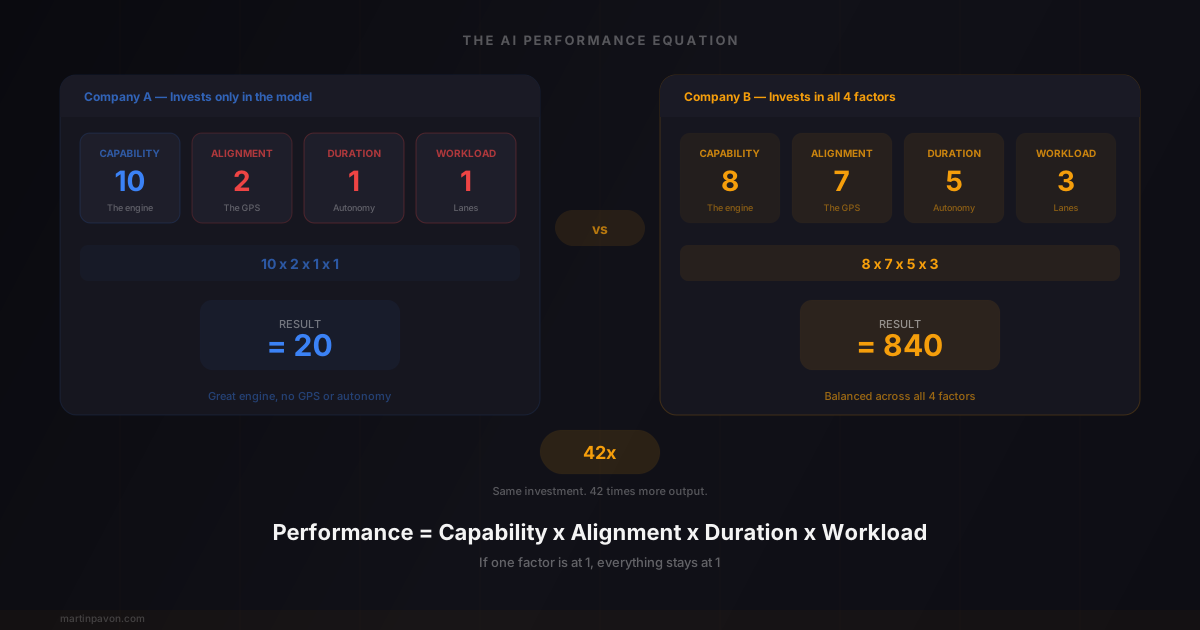
Let's look at the numbers. Two companies, same AI investment, radically different results.
Company A
- Capability: 10 (best model on the market)
- Alignment: 2 (zero business context)
- Duration: 1 (constant supervision)
- Workload: 1 (one task at a time)
Result: 10 x 2 x 1 x 1 = 20 points
They spent everything on the model. They ignore the rest.
Company B
- Capability: 8 (good model, not the most expensive)
- Alignment: 7 (deep business context)
- Duration: 5 (automatic verification)
- Workload: 3 (three parallel workflows)
Result: 8 x 7 x 5 x 3 = 840 points
They invested in all 4 factors evenly.
- 42xReal difference
- Same investment, 42x more output
- 80%Less model cost
- Company B spends less on the model and performs better
Company B doesn't have a more powerful tool. They have a better strategy. And they spend less.
The Right Sequence: Don't Skip Steps
Capability: ensure the minimum
Choose a capable AI tool. In 2026, almost all of them are. You don't need the most expensive one. You need one that's "good enough" for your tasks. Time: 1 day.
Alignment: the biggest multiplier
Invest most effort here. Document your processes, business rules, formats. Give the AI the context it needs. Time: 1-2 weeks. Return: immediate and massive.
Duration: let it iterate alone
Set up automatic verification. Let the AI review its own work before delivering. This requires Alignment to be high — if it doesn't know what to look for, it can't verify. Time: 1-2 weeks.
Workload: scale
Only when the other three are high. Scaling before multiplies errors. Scaling after multiplies results. Time: continuous, incremental.
Most companies skip to step 4 without going through 2 and 3. It's like hiring 10 new employees without having clear processes. More people, more chaos.
Improve Your Weakest Factor: The Chain Principle
A chain is only as strong as its weakest link. And in this equation, the lowest factor is your biggest opportunity.
You don't need to be perfect across all four factors. You need none of them to be at 1.
If your company already has good Capability (probably yes) but low Alignment (almost certainly), the answer is obvious: don't switch models. Give context to the tool you already have.
If you already have good Alignment but the AI needs constant supervision, the next step is Duration: set up automatic verification.
If your operations are running well and the AI already works autonomously, then — and only then — scale the Workload.
Don't look for the perfect model. Find your weakest factor and improve it. That's where 80% of the result lies.
Your Next Step
Before switching tools, before trying the new model that came out this week, before hiring an AI consultancy:
- Score your 4 factors from 1 to 10. Be honest.
- Identify the lowest one. That's your bottleneck.
- Act on that factor. Not on the one that excites you most.
If you want us to help identify where your bottleneck is and how to improve each factor for your specific case, let's talk.
The 4 Factors: What Each One Means for Your Business
| Factor | What it is | Low value consequence | How to improve |
|---|---|---|---|
| Capability (C) | Raw power of the AI model | Tool cannot do the task | Upgrade model — but this is rarely the bottleneck |
| Alignment (A) | How much the AI knows your business | Generic, unusable answers | Document business rules and context |
| Duration (D) | How long AI can work without supervision | Constant human babysitting | Build verification loops and checkpoints |
| Workload (W) | How many tasks running in parallel | Slow, serial execution | Design for parallel agent execution |
The equation is C × A × D × W. If any single factor is 1, the result is 1 — regardless of how high the others are. According to Gartner's AI productivity research, less than 20% of AI implementations address all four factors simultaneously, which is why most produce underwhelming results.
The Optimization Sequence: Always Follow This Order
Most businesses optimize in the wrong order and get poor results. Here is the correct sequence:
- Ensure minimum viable Capability — the model must be able to do the task type. Most modern models already qualify for 90% of business tasks.
- Maximize Alignment — give the AI your business context: rules, decisions, terminology, exceptions. This has the highest ROI of any optimization.
- Extend Duration — build checkpoints and verification steps so the AI can work longer without requiring constant supervision.
- Scale Workload — only after the above three are solid, run tasks in parallel to multiply total output.
Businesses that follow this sequence see 10–40x performance improvement without switching models or increasing AI budgets — the gains come from strategy, not spending.
The Equation in Practice: Real Outcome Data
The numbers speak clearly across real implementations:
- A team operating at C=8, A=8, D=5, W=5 processes 5x more tasks than one at C=8, A=2, D=2, W=2
- Improving Alignment (business context) alone typically delivers a 3x performance gain with no other changes
- Without Duration optimization, human oversight is needed every 15 minutes — effectively canceling any time savings
- Companies that address all 4 factors report handling 10 to 20x the work volume without headcount growth
- The typical ROI window from implementing the full equation: 60 to 90 days from start to measurable results