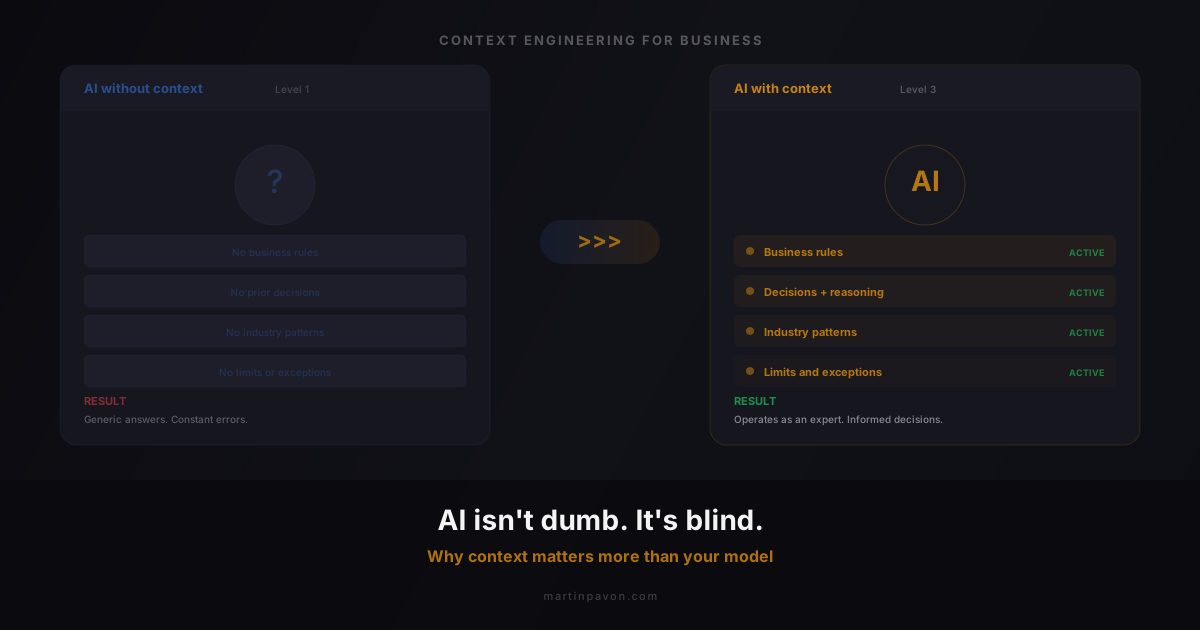

You hire a senior. Tell them nothing. Then wonder why they underperform.
Imagine this: you hire the best professional on the market. Twenty years of experience, knows every tool, has solved problems harder than yours. You sit them at their desk on day one.
And you give them nothing.
No manual. No project context. No access to prior decisions. No explanation of why things are done the way they are. You just say: "get to work."
That's exactly what 90% of businesses do with their AI tools.
They buy the best model. The most expensive tool. The premium subscription. And then they complain that "the AI doesn't understand our business." Of course it doesn't. No one ever explained it.
The problem isn't intelligence. It's blindness.
There's a widespread idea that to get better results from AI, you need a more powerful model. More parameters. More capability. It's like thinking that to get more from an employee, you need to hire someone smarter.
But reality is different.
- 3-5xperformance improvement
- when the same AI has access to well-designed context vs. no context at all
- 40%of AI tool time wasted
- is spent 'exploring' — searching for information that should already be available
- 90%of AI implementations
- in businesses include no context strategy whatsoever
The difference between an AI tool that gives generic answers and one that operates as an expert in your field isn't the model. It's the context.
And that's where a concept that is redefining how software is built with AI comes in: context engineering.
Context engineering: the concept nobody explained to you
You've probably heard of prompt engineering — the art of asking AI good questions. Writing clear, structured instructions with examples. It's useful. But it's just the tip of the iceberg.
Prompt Engineering
How you phrase the question
- A specific instruction
- Optimizing words and format
- Result: one-off improvement
- Analogy: asking a stranger a good question
Context Engineering
What the tool knows BEFORE you ask
- All business knowledge available
- Rules, decisions, patterns, boundaries
- Result: systematic and lasting improvement
- Analogy: a complete onboarding for a new hire
Prompt engineering tells the AI how to respond. Context engineering gives it everything it needs to respond like an expert — without you having to re-explain it every time.
It's the difference between asking a stranger on the street for directions... and giving them a GPS with a full map of the territory, shortcuts, roadworks, and closed roads.
The 3 levels of context (and where your business stands)
Not all AI implementations are equal. And the difference almost always comes down to how much context the tool has to work with.
No context: the lost junior
You give the AI access to your business without explaining anything. It doesn't know what you sell, how you operate, what your rules are, or what mistakes to avoid.
Result: generic answers, constant errors, you have to review everything manually. The tool knows a lot about everything but nothing about you.
It's like putting a recent graduate in charge of your operation with no training. They have a degree, but no idea how your business actually works.
Basic context: the employee with a manual
You give it some instructions. A document with general rules. Maybe a description of your company. The AI improves, but still makes errors on edge cases — those that "everyone knows" but nobody documented.
Result: useful for simple tasks, but fails on complexity. Requires constant supervision.
It's like giving someone the company welcome handbook but not introducing them to the team, not explaining ongoing projects, or why each decision was made.
Designed context: the senior who knows the business
The tool has structured access to: business rules, prior decisions and why they were made, patterns that work, common mistakes and how to avoid them, and the knowledge that normally only lives in the founder's head.
Result: operates as an expert from minute one. Makes informed decisions. Detects problems before they happen. Learns from historical context.
It's like that employee who's been with the company for 5 years and "just knows" how to do things. The difference is it didn't take 5 years — it took as long as it takes to structure the knowledge.
Most businesses are at Level 1 and blame the model. Moving to Level 3 with the same model changes everything.
5 signs your AI is operating blind
How do you know if your AI implementation has a context problem? These are the clearest signals:
1. You have to repeat the same instructions over and over. If every time you use the tool you have to explain the same things — that you're a nautical charter company, that your clients are European, that your prices are per week — your AI has no persistent context. It's starting from zero every time.
2. The answers are correct... but generic. The AI responds well in general, but misses the nuances of your sector. It talks about "customers" when you say "guests." It suggests processes that don't apply to your industry. It knows everything about everything, but nothing about yours. This is exactly why specialized software beats generic — and the same applies to AI.
3. It fails exactly where it matters most. On edge cases. On exceptions. On those situations that happen once a month but when they do, they cost a lot. That's where invisible context — the kind that only exists in your team's heads — makes the difference.
4. Someone on your team has to review everything the AI produces. If a team member has to validate every output before it's usable, you're not saving time — you're just moving it. An AI with good context produces outputs that can be used directly 80% of the time.
5. You tried AI tools, they "didn't work," and you went back to manual. This is the most common signal. The business tries ChatGPT, or a CRM with AI, or an automation tool, and concludes that "AI isn't ready for our business." In 90% of these cases, the problem wasn't the tool. It was the lack of context. (If this sounds familiar, you'll probably also recognize these 5 signs you need a custom system.)
How to build good context (without being technical)
The most valuable part of context engineering doesn't require knowing how to code. It requires knowing your business and being willing to document it in a structured way.
Here are the 4 fundamental steps:
1. Document the unwritten rules
Every business has dozens of rules that "everyone knows" but nobody has ever written down. They're the ones the founder explains to every new hire. The ones learned through experience. The ones that cause errors when someone new ignores them.
Examples: "We never accept bookings shorter than 3 days in peak season," "Quotes for businesses always include VAT broken out," "If a client asks about August availability, we always offer September alternatives."
These rules are gold for AI. Without them, the tool operates with generic logic. With them, it operates with your business logic.
2. Record decisions and the reasoning behind them
It's not enough to document what was decided. You need to document why. Because that decision has context, and that context is what enables good future decisions.
"We stopped offering discounts over 15%" isn't enough. "We stopped offering discounts over 15% because we found that high-discount clients had 40% more cancellations" — that's context an AI can actually use.
3. Structure knowledge in layers
Not all information has the same importance or is needed at the same time. The trick is organizing it in layers:
- General layer: What your company does, what sector it operates in, what your business model is
- Operational layer: How your processes work, rules for each area, workflows
- Specific layer: Details of each product, service, or particular situation
A well-configured AI loads the general layer always, the operational layer when relevant, and the specific layer only when needed. That way it's neither overloaded with irrelevant information nor short on critical context.
4. Keep it alive
The worst context is outdated context. If you document everything today and don't touch it for 6 months, your AI will be operating with obsolete rules. It's like that senior employee we mentioned at the start going on a 6-month vacation and coming back assuming nothing changed.
The solution isn't to rewrite everything each month. It's having a system where updates are integrated naturally — when a rule changes, the document is updated. When a new decision is made, it's recorded. That way the context grows and improves over time instead of rotting.
The difference in numbers
We build AI-powered systems for businesses across different sectors. And the results when context engineering is applied well are consistent:
- 80%less oversight
- The AI produces outputs that can be used directly, without constant manual review
- 3-5xmore productivity
- Same tool, same cost — but with designed context it performs exponentially better
- Weeksnot months
- Implementing basic context engineering takes weeks. ROI appears from the first month
And most importantly: it doesn't require changing tools. The model you're already using is probably sufficient. What it needs is information, not more power.
You don't need a smarter AI. You need an AI that knows what you know.
Context Engineering in 4 Steps: The Practical Checklist
You do not need a technical background to start. Here is the exact sequence:
- Document your unwritten business rules — every "everyone knows this" that no one has written down.
- Record important decisions and the reasoning behind them, not just the outcome.
- Structure knowledge in layers: general (what you do), operational (how you do it), specific (edge cases).
- Keep context alive — update it when rules change, so the AI never operates on stale assumptions.
This four-step process is what separates businesses that get 10% of AI's value from those that get 80%.
Prompt Engineering vs Context Engineering: Side-by-Side
These two disciplines are often confused. The difference determines whether your AI gives generic or expert-level answers:
| Dimension | Prompt Engineering | Context Engineering |
|---|---|---|
| Scope | One specific question or task | Everything the AI knows before you ask |
| Duration | One session, one response | Persistent across all sessions |
| Who does it | Anyone who writes prompts | Requires structured knowledge design |
| ROI horizon | Immediate (one better answer) | Compounding (every answer improves) |
| Analogy | Asking a good question | Onboarding a new expert hire |
| Result | One-off improvement | Systematic, lasting performance gain |
90% of AI implementations include no context strategy at all — which is why most businesses are operating their AI at 10–20% of its real potential.
Context Engineering: Measured Outcomes
The data from real implementations is consistent:
- AI with designed context requires human review only 1 vez in 5 outputs — vs every single output without context
- Documenting business rules takes an average of 20 to 40 hours of founder time — once. Not per month, not per year.
- The same AI model performs 3 to 5x better on business tasks when given structured context vs no context
- Teams that implement context engineering report saving 2 hours per employee per day on AI-assisted tasks
- Context documentation pays back its time investment in the first 30 days of use in most implementations
Context Engineering: Three Numbers That Sum It Up
Three data points that explain why context is the most valuable thing you can build:
- 3x: the minimum performance improvement measured when the same AI model has well-designed context versus no context
- 30 days: the typical time for a business to recover the investment in context engineering — just from reduced review time and better first-pass outputs
- 73% of companies that try AI tools and abandon them had no context strategy — the tool was not the problem
These three data points are why context engineering is the highest-ROI AI investment most businesses can make in 2026.
The competitive advantage nobody sees
While most businesses are racing to use "the best AI model," the ones actually pulling ahead are those who have understood something more subtle: the model matters less than the context.
It's like the early 2000s with the internet. The businesses that won weren't the ones with the fastest connection — they were the ones that understood how to use the internet to transform their operations.
It's the same with AI. The advantage isn't in having access to GPT-4, Claude, or Gemini. The advantage is in having the context that makes any of those tools work like an expert in your sector.
And that advantage — unlike the model, which anyone can buy — is unique. Because your context is your business. Your experience. Your decisions. Your rules. And that can't be copied.
If your business already uses AI tools but you feel you're not getting their full potential, you probably have a context problem, not a technology problem. And it's easier to solve than you think. (If you're also starting to digitize your business, context is what will make every tool you implement work from day one.)
We can help you design the context your operation needs so AI works like an expert from the very first day.