
80% Think They "Already Use AI". They're Wrong.
Ask any business owner if they use artificial intelligence and they'll say yes. "Of course, we use ChatGPT." And technically they're right. But using ChatGPT to draft an email is like saying you "know how to drive" because you once moved a car in a parking lot.
The reality is harsh: most companies that say they use AI are at the lowest level of adoption. They ask one-off questions, copy and paste answers, and believe that makes them "digitally transformed".
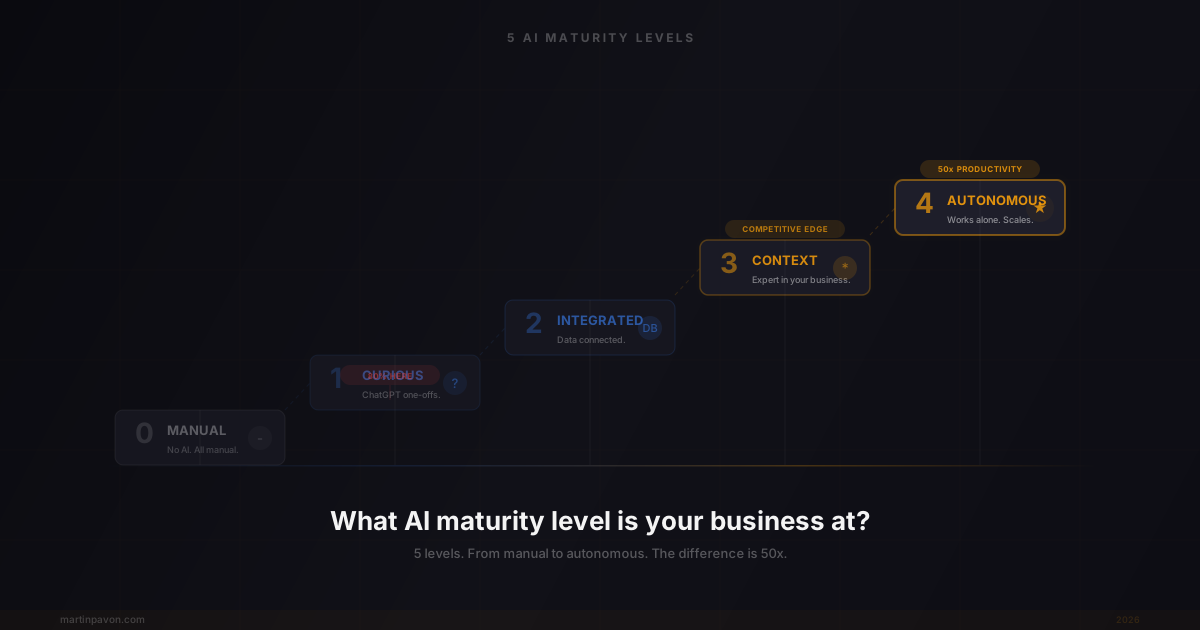
The difference between a Level 1 company and a Level 4 company isn't 2x or 5x. It's 50x in productivity. And that gap widens every day.
There are 5 clear maturity levels in the use of artificial intelligence. Knowing which one you're at is the first step to stop losing ground to those who are already higher up.
Why the Levels Matter: Each Jump Multiplies
This isn't a linear scale where each level "adds a little bit". Each level multiplies the impact of the previous one.
At Level 1, AI saves you minutes on one-off tasks. At Level 2, it saves you hours by eliminating manual work. At Level 3, it makes informed decisions that used to require your time. At Level 4, it executes complete processes while you focus on strategy.
- Level 1Point savings
- Minutes per task. Copy-paste.
- Level 3Integrated expert
- Hours per day. Contextual decisions.
- Level 4Autonomous operation
- Weeks per month. Complete processes.
The problem is that most companies are stuck at Level 1, convinced that they "already use AI". And while they stay there, their competition is scaling.
The Numbers: Where Businesses Actually Stand in 2026
Before exploring each level, here is the reality of where most businesses sit today:
- 73% of businesses are at Level 0 or 1 — using AI only for one-off tasks or not at all
- Companies at Level 3 are 5x more productive on the tasks where AI is deployed vs Level 1
- The transition from Level 1 to Level 2 takes an average of 4 weeks with the right guidance
- Businesses at Level 4 report handling 10x the work volume without adding headcount
- Only 8% of businesses operate at the equivalent of Level 3 or above, according to McKinsey
The opportunity window is real. The businesses that reach Level 3–4 first will establish an advantage that takes competitors 2 to 3 years to close — if ever.
The 5 AI Maturity Levels
Level 0 — Manual
You don't use AI. Everything is manual or with traditional tools.
You're the company that still manages everything with Excel, email and phone calls. It's not that AI doesn't apply to your business — it's that you haven't started.
Signs you're here:
- You don't use any artificial intelligence tools
- Your team distrusts AI or doesn't know where to start
- All your processes are manual or depend on tools from 10 years ago
What staying here costs you: Every repetitive task you do by hand could be done by AI in seconds. Every client response that takes hours could be ready in minutes. The cost isn't visible — but it accumulates.
Level 1 — Curious
You use ChatGPT or similar occasionally. One-off questions. No integration.
This is the trap level. You think you use AI, but what you're doing is consulting a generic oracle that knows nothing about your business. You copy the response, paste it somewhere else, edit it... and in the end it takes almost as long.
Signs you're here:
- You use ChatGPT, Gemini or similar for one-off questions
- You copy and paste responses into your documents
- AI has no access to any company data
- Every conversation starts from zero — it remembers nothing
What staying here costs you: You're using a Ferrari to go to the corner shop. The potential is there, but without connection to your reality, answers are generic and often useless for real decisions.
Level 2 — Integrated
AI is connected to your systems. It has access to real data. But without business context.
This is where many technologically advanced companies get stuck. They've connected AI to their databases, their documents, their CRM. It can query real data. But it doesn't know what those data points mean in the context of your business.
Signs you're here:
- AI can access your documents or databases
- You can ask it questions about real company data
- But answers are "technically correct" without being truly useful
- It doesn't understand your business rules, exceptions or priorities
What staying here costs you: You have the data connected but AI interprets it like a new intern — it sees the numbers but doesn't understand the business behind them. Answers sound good but aren't useful for real decisions.
Level 3 — Contextualized
AI knows your business. It has rules, patterns, prior decisions. It operates as an expert.
This is the level that changes everything. AI doesn't just access your data — it understands your business. It knows that "premium client" in your company means something different than in another. It knows your rules, exceptions, decision patterns. This is what's called context engineering.
Signs you're here:
- AI responds like someone who's been in your company for years
- It applies your business rules without needing reminders
- It proposes solutions that consider history and context
- The factors that determine AI performance are optimized
What you gain when you reach here: An expert available 24/7 who knows your business like you do. Who forgets nothing, has no bad days, can handle 10 clients simultaneously with the same quality.
Level 4 — Autonomous
AI works independently, verifies its own work and scales. You supervise results, not processes.
The final level. AI doesn't just know — it acts. It executes complete processes from start to finish. It detects problems before you see them. It proposes improvements based on patterns it has identified. And it verifies its own work before delivering.
Signs you're here:
- AI executes complete workflows without human intervention
- It verifies the quality of its own output before presenting it
- It scales automatically according to demand
- You review final results, you don't supervise every step
What you gain when you reach here: Your business operates at a speed that previously required a team 10 times larger. You're not delegating tasks to AI — you're delegating responsibilities.
AI Maturity Levels at a Glance
This table lets you diagnose your level in under two minutes:
| Level | Label | What the AI does | Example | Productivity gain |
|---|---|---|---|---|
| 0 | Manual | Nothing — all work is human | Excel, phone, email | Baseline |
| 1 | Curious | One-off Q&A, copy-paste | ChatGPT for email drafts | 5–10% |
| 2 | Integrated | Accesses real data, no business context | AI reads your CRM data | 20–30% |
| 3 | Contextualized | Knows your rules, patterns, decisions | Responds like a 5-year employee | 3–5x |
| 4 | Autonomous | Executes complete workflows independently | End-to-end process automation | 10–50x |
According to McKinsey's State of AI report, only 8% of companies operate at the equivalent of Level 3 or above. 80% are stuck between Levels 1 and 2.
How to Move Up: The 4-Step Level Transition
You cannot skip levels. Here is the proven sequence for each transition:
- Level 0 → 1: Start with any general AI tool (ChatGPT, Gemini) for 10 common daily tasks. Goal is losing the fear, not productivity.
- Level 1 → 2: Connect AI to one real data source — your CRM, your order list, your document library. One connection, not five.
- Level 2 → 3: Document your business rules, key decisions, and common exceptions. Give AI the context it needs to stop being generic.
- Level 3 → 4: Define one complete process end-to-end. Let the AI execute it with a human checkpoint at the end. Expand from there.
73% of SMBs have no AI adoption plan, which is the primary reason most stay permanently at Level 1. A plan does not need to be complex — the 4 steps above are the entire plan.
What Level You're At: The 2-Minute Test
AI Maturity Self-Assessment
Mark the statements that apply to your company
We don't use any AI tools in our daily operation
Si si → You're at Level 0 — Manual. Every day without AI is productivity being lost.
We use ChatGPT or similar, but only for one-off questions (copy-paste)
Si si → You're at Level 1 — Curious. You're using 5% of available potential.
AI has access to our data, but answers are generic
Si si → You're at Level 2 — Integrated. You're missing business context to make the leap.
AI knows our business rules and responds like an internal expert
Si si → You're at Level 3 — Contextualized. You're in the elite. The next step is autonomy.
AI executes complete processes and I only supervise results
Si si → You're at Level 4 — Autonomous. You're one of the few companies that operates this way. Maintain the advantage.
Tu puntuacion
How to Level Up: The Practical Path
Here comes the part nobody tells you: you can't skip levels. Each level builds on the previous one. And the reason so many companies fail with AI is because they try to go from 0 to 4 in one jump.
What DOESN'T work
- Buying an expensive AI tool without having clear processes
- Trying to "automate everything" at once
- Giving data access without defining business rules
- Expecting AI to "learn on its own" without context
- Copying what another company does without understanding your current level
What DOES work
- Identifying your current level honestly
- Choosing ONE process to move to the next level
- Connecting AI to real data from that process
- Defining your business rules and context step by step
- Measuring results and expanding gradually
From Level 0 to 1: Start Experimenting
No budget or technical team required. Start using AI tools for everyday tasks: drafting emails, summarizing documents, researching topics. The goal isn't immediate productivity — it's for you and your team to lose the fear and understand what's possible.
From Level 1 to 2: Connect AI to Your Reality
This is the first technical leap. You need AI to stop being a generic chat and start working with your data. This can be as simple as giving it access to your internal documents or as complex as integrating it with your management system. The result: it goes from generic answers to answers based on your real information.
From Level 2 to 3: Give It Business Context
This is where most people get stuck — and where the biggest value leap happens. It's not enough for AI to see your data. It needs to understand what it means. It needs to know your rules, priorities, exceptions. This is context engineering and it's the difference between an intern with server access and an operations director with 10 years of experience.
From Level 3 to 4: Delegate Responsibilities
Once AI understands your business like an expert, the next step is letting it operate. Execute complete processes. Verify its own work. Scale according to demand. You go from supervising every step to reviewing final results.
The Early Mover Advantage: A Race That Won't Wait
This isn't a trend you can "evaluate at your leisure". It's a race. And the companies that reach Level 3-4 first will establish an advantage that will be nearly impossible to close.
- 50xProductivity difference
- Between Level 1 and Level 4
- 73%SMEs without AI plan
- Have no adoption strategy
- 2-3 yearsOpportunity window
- To establish competitive advantage
Think about what happened with the internet in the 2000s, with mobile in the 2010s, with ecommerce in the 2020s. Companies that moved first didn't just gain market share — they redefined the rules of the game. Those that waited had to compete in a field others had designed.
The same is happening with AI. But faster.
The business with contextualized AI operating as an internal expert will be able to serve more clients, with better quality, at lower cost. That's not an incremental advantage — it's a paradigm shift that affects the entire equation.
The question isn't whether AI will transform your industry. It's whether you'll be the one transforming it or the one adapting to others' transformation.
Frequently Asked Questions About AI Maturity
What level is most common for businesses right now?
Level 1 (Curious) is where approximately 73% of businesses sit today. They use AI tools but have not connected them to real business data or context. Most businesses spend 6 to 18 months at Level 1 before making a deliberate move to Level 2.
How many veces more productive is Level 4 vs Level 1?
The productivity gap is not linear — it is multiplicative. Businesses operating at Level 4 can handle 10 to 50x more work with the same team, because AI executes complete processes autonomously. The bottleneck shifts from execution capacity to decision quality.
Does moving to the next level require a technical team?
From Level 0 to Level 2, no. Anyone can start using AI tools and connect them to existing data. From Level 2 to Level 3, you need someone who can structure your business knowledge — this takes 4 to 8 weeks of focused documentation work. From Level 3 to Level 4, you need a technical partner to build the autonomous workflows.
What is the minimum viable investment to reach Level 3?
For most SMBs, the investment is primarily time, not money. Documenting your business rules and context takes 20 to 40 hours of founder or operations manager time. The technical side — connecting that context to the AI — ranges from minimal configuration to custom development depending on your existing tools.
Is reaching Level 4 necessary for all businesses?
Not at all. For many businesses, Level 3 (contextualized AI that responds like an expert) delivers the majority of the available value. Level 4 (fully autonomous execution) makes the most sense for businesses with high-volume, repeatable processes — like order management, customer support, or report generation.
The Next Step Is Simpler Than You Think
You don't need a 50-page digital transformation plan. You don't need an AI department. You don't need a million-dollar budget.
You need three things:
- Know what level you're at — you already know if you did the test
- Choose one concrete process — the most painful, the most time-consuming
- Take the step to the next level — with that process, not everything at once
Every level you climb doesn't just improve that process. It changes how your company operates, competes and grows.
The opportunity window is open. It won't stay open forever.