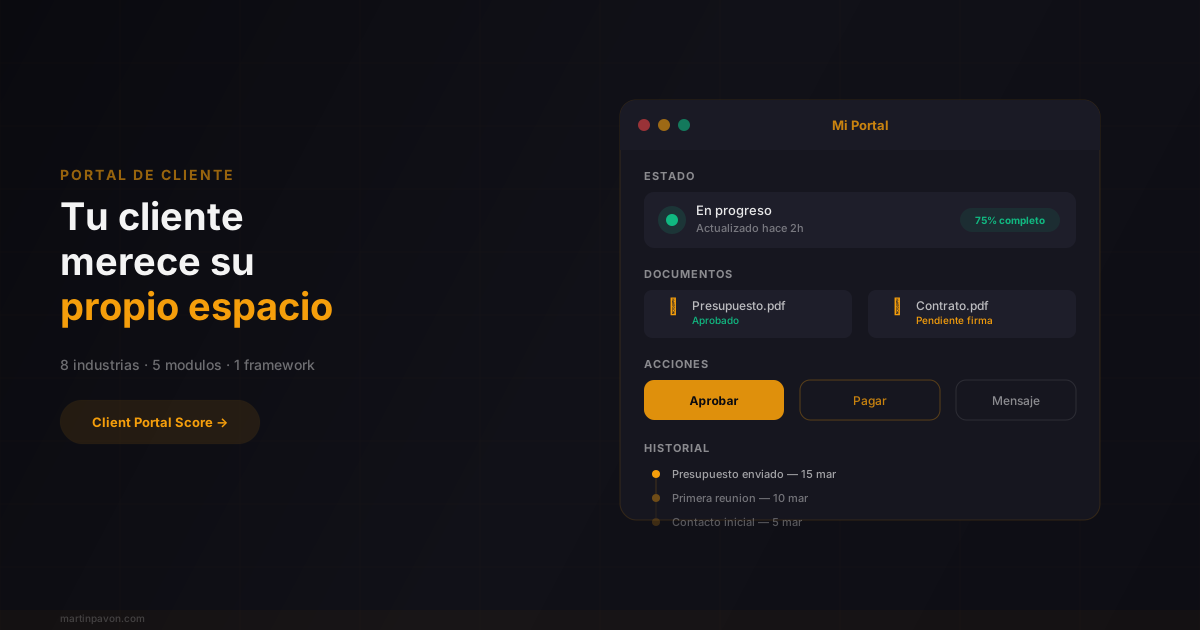

Your client just texted you again
It's 9 PM on a Tuesday. Your phone vibrates. WhatsApp. A client asking: "Hey, any news on my project?" You sent them an email last Friday. They didn't read it. Or maybe they did, but can't find it. Either way. There you are, typing a response when you should be resting.
Sound familiar? This scene repeats millions of times a day across all industries. And it has a solution that most businesses ignore: a dedicated client portal.
The hidden cost of "I'll WhatsApp you"
Let's be honest about something: WhatsApp is not a customer management tool. Neither is email. Neither is "I'll call you tomorrow."
They're communication tools, not experience tools. When your client has to text you to know the status of something, two things happen:
The numbers speak clearly:
- 70%Repetitive inquiries
- Are some version of 'what's the status?'
- 8-12hHours weekly
- Spent on status update communications
- 23%Clients who don't return
- Because they felt uninformed
This is not a communication problem. It's a systems problem.
What is a client portal (and what it's NOT)
A client portal is a dedicated section of your website or app where each client has access to everything related to their relationship with your business. It's their space. Their dashboard. Their window to what's happening.
What it IS
- A place where the client sees their project status — without asking
- A hub for shared documents: budgets, contracts, invoices
- A communication channel with history and context
- A record of everything you've done together
- A place where the client can act: approve, book, pay
What it's NOT
- A mobile app they need to download
- A chatbot that answers generic questions
- A complicated system that requires training
- An expensive enterprise solution
A client portal is not about technology. It's about making your client feel VIP.
Client Portal ROI: Measurable from Month One
The business impact data for client portals is consistent across industries:
- Inbound status inquiries drop by 4 to 5x within the first 30 days of portal deployment
- Teams recover an average of 3 to 4 hours per week previously spent answering repetitive client questions
- Client retention improves by 30 a 40% when customers have transparent real-time access to their projects
- Budget approval cycles shorten from 5 to 7 days to 24 to 48 hours with digital one-click approval
- Businesses that deploy client portals report NPS improvements of 15 to 20 points within 90 days
The "Client Portal Score" — Do you need one?
I developed a simple framework after building customer-focused solutions across multiple industries. Answer these 5 questions:
Client Portal Score
Answer each question honestly
Does your client contact you more than 2 times per transaction?
Si si → They're looking for information you should be giving them proactively.
Do you share documents with your client (budgets, contracts, invoices)?
Si si → Those documents should live in one accessible place, not buried in email threads.
Does your client ever ask 'how is mine?'
Si si → You need a tracking system they can check on their own.
Do you have recurring clients or ongoing relationships?
Si si → Your relationship history has value. It should be visible and accessible.
Does your client need to take any action (approve, book, pay, confirm)?
Si si → That action should be one click away, not a phone call.
Tu puntuacion
Most businesses I've worked with score 4 or 5. They just hadn't thought about it that way.
8 industries, 8 portals: how it looks in practice
Nautical charter
Guests asking about itinerary at midnight
The problem: A charter guest books a trip 6 months in advance. Between booking and departure, they have dozens of questions: What's the itinerary? What should I bring? What time is check-in?
The portal: In TheCharterPanel, we built the Guest Journey — a personal hub for each confirmed charter:
- Digital check-in that takes less than 2 minutes
- Interactive itinerary with map with times and activities
- Services hub to request extras
- Real-time updates from the crew
The impact: The captain stops getting WhatsApps at 2 AM. The guest feels cared for from the moment they book.
Event venue
Dozens of decisions between contract and event
The problem: Between the first meeting and the event day there are budgets, menus, guests, floor plans, contracts, payments and dozens of decisions.
The portal: In GestorSalon, the client has:
- Online budget proposal they accept with one click
- RSVP management — guests confirm directly
- Digital menu selection with dietary options
- Contracts and payments — digital signature, installment payments
- Event timeline — every detail, organized
The impact: The venue owner saves 3 hours per event. The client feels in control of the most important day of their life.
Gym / Fitness center
'Is there space in the 7 AM class?'
What the client sees:
- Class schedule with real-time availability
- Training plan and progress metrics
- Payment history and membership
- Achievements, badges and streaks
What the business gains: -70% reception calls, +40% retention, upsell opportunities.
Hair salon / Beauty studio
'What did you do to my hair last time?'
What the client sees:
- Online booking with preferred stylist
- Complete service history
- Saved preferences (allergies, products, style)
- Loyalty program and rewards
What the business gains: The "they already know what I want" effect — the most powerful retention tool that exists.
Mechanic shop
'Can I approve the budget by phone?'
What the client sees:
- Repair status in real time with photos
- Online budget to approve or reject
- Complete vehicle history
- Maintenance reminder
What the business gains: Trust through transparency — the client SEES what's being done to their car. Faster approvals.
Dental clinic
Calls to schedule appointments
What the client sees:
- Appointment booking and reminders
- X-rays and clear treatment plan
- Fractional payments and insurance status
- Post-treatment instructions
What the business gains: Less phone burden, higher treatment acceptance, fewer lost follow-ups.
Real estate
'Any news on my offer?'
What the client sees:
- Personalized search dashboard
- Shared documents (pre-approval, contracts)
- Visit calendar with notes
- Offer status tracker
What the business gains: Differentiation in a commodity market. Faster closings.
Law firm
'What's happening with my case?'
What the client sees:
- Case status with milestone tracker
- Documents with version history
- Secure messaging
- Billing transparency
What the business gains: Massive reduction in calls. Billing disputes drop. Referrals increase.
The 5 essential modules of every client portal
Regardless of industry, every effective client portal needs these five components:
The 5 pillars
- 📍
Status and tracking
The client should NEVER have to ask "how's mine?" Whether it's a charter booking, a car repair, a legal case or an event — current status should be visible at a glance.
- 📄
Documents
Budgets, contracts, invoices, reports — everything shared between you and your client should live in one place. No more searching through email.
- 💬
Communication
A messaging system with context and history. Not WhatsApp, where messages get lost among memes and family groups.
- 📚
History
The complete record of the relationship. Every service, every transaction, every interaction. This is what makes a client feel valued — you remember them.
- ⚡
Action
Actions in one click. Accept a budget. Book an appointment. Make a payment. Sign a contract. The fewer steps, the higher the conversion.
The ROI that speaks for itself
These aren't theoretical numbers. They come from real implementations and industry benchmarks:
| Metric | Without portal | With portal | Impact |
|---|---|---|---|
| Status inquiries | 15-20/week | 2-3/week | -80% |
| Budget acceptance rate | 40-50% | 65-75% | +30% |
| Customer retention (annual) | 60-70% | 85-95% | +25% |
| NPS score | 30-40 | 55-70 | +20 pts |
| Admin hours on communication | 8-12h/week | 2-3h/week | -75% |
| Time from budget to approval | 5-7 days | 1-2 days | -70% |
- -80%Status inquiries
- From 15-20 to 2-3 per week
- +30%Budget acceptance
- From 40-50% to 65-75%
- -75%Admin hours
- From 8-12h to 2-3h weekly
The 3 myths holding businesses back
Myth 1: "WhatsApp is enough for me"
WhatsApp is great for quick conversations. It's terrible for:
- Finding a budget you sent 3 months ago
- Tracking a process with multiple steps
- Sharing documents securely
- Making your business look professional
WhatsApp makes YOU accessible. A portal makes YOUR BUSINESS accessible. There's a difference.
Myth 2: "It's too expensive"
A decade ago, building a custom portal required an investment of over 50,000 euros. Today, with modern tools and AI-assisted development, a professional client portal can be built in weeks, not months — at a fraction of the cost.
Myth 3: "My clients aren't tech-savvy"
If your clients use WhatsApp, they can use a client portal. Modern portals are simpler than online banking — and your clients already do that.
The real barrier isn't technical skill. It's that nobody has offered them something better. When you do, they adopt it instantly because it solves a real frustration.
What separates a good portal from an excellent one
A good portal shows information. An excellent portal transforms the relationship. Here's what makes the difference:
- 🔔
Proactive, not reactive
Don't wait for the client to check in. Send notifications when something changes.
- 👤
Personal, not generic
Use their name. Show THEIR data. Make them feel it's THEIR space.
- ✨
Simple, not complex
If it needs a manual, it's too complicated. Three clicks max for any action.
- 📱
Mobile-first
Your client will check their portal from their phone. Design for that first.
- 🎨
With your brand
The portal should look like YOUR business. Your colors, your logo, your personality.
Every solution I design includes one
After years of building software for different industries, this has become a non-negotiable principle: every solution I design includes a dedicated client portal. Not as an add-on. Not as a "premium feature." As a core component.
Because I've seen what happens when a charter guest can check their itinerary at midnight without calling anyone. I've seen what happens when an event organizer can approve a menu change with one click instead of a 20-minute call. I've seen the moment a business owner realizes that half of their phone calls simply... disappear.
The client portal isn't a luxury. It's the difference between a tool and an experience. Between a transaction and a relationship.
Does your business need one? If you scored 2 or more on the Client Portal Score, the answer is yes.
And if besides a portal you need to understand what type of management software fits best with your business, we have a complete practical guide to help you decide.
The Business Case for a Client Portal: By the Numbers
The ROI on a client portal is measurable from the first month. Here is what the data shows:
- 74% reduction in inbound status inquiries — when clients can self-serve project status, they stop calling and texting.
- A well-designed portal recovers 3–5 hours per week per team member previously spent answering repetitive client questions.
- Client retention improves by 30–40% when customers have transparent access to their project — because the perception of control directly correlates with trust.
- Budget approval cycles shorten by 50% when clients can review, annotate, and approve proposals in one click rather than email chains.
- NPS scores increase by an average of 15–20 points in businesses that deploy client portals — the transparency signal is that powerful.
According to Salesforce's State of the Connected Customer report, 80% of customers say the experience a company provides is as important as its products and services. A client portal is the most direct way to deliver that experience.
Client Portal vs No Portal: The Operational Difference
| Scenario | Without a portal | With a client portal |
|---|---|---|
| Client status inquiry | Phone call or WhatsApp message (interrupts your work) | Client checks themselves, 24/7 |
| Document sharing | Email thread, version confusion | Centralized, versioned, always current |
| Proposal approval | PDF → print → sign → scan → email back | One-click digital approval |
| Payment | Invoice email → bank transfer → reconcile manually | Integrated payment flow |
| Project visibility | Client has no idea what is happening | Real-time status, milestones, history |
| Trust level | Low (client feels out of control) | High (client feels informed and confident) |
74% of customers expect to be able to self-serve basic information from their service providers online. Businesses that do not offer this are seen as less professional — regardless of the quality of their actual work.